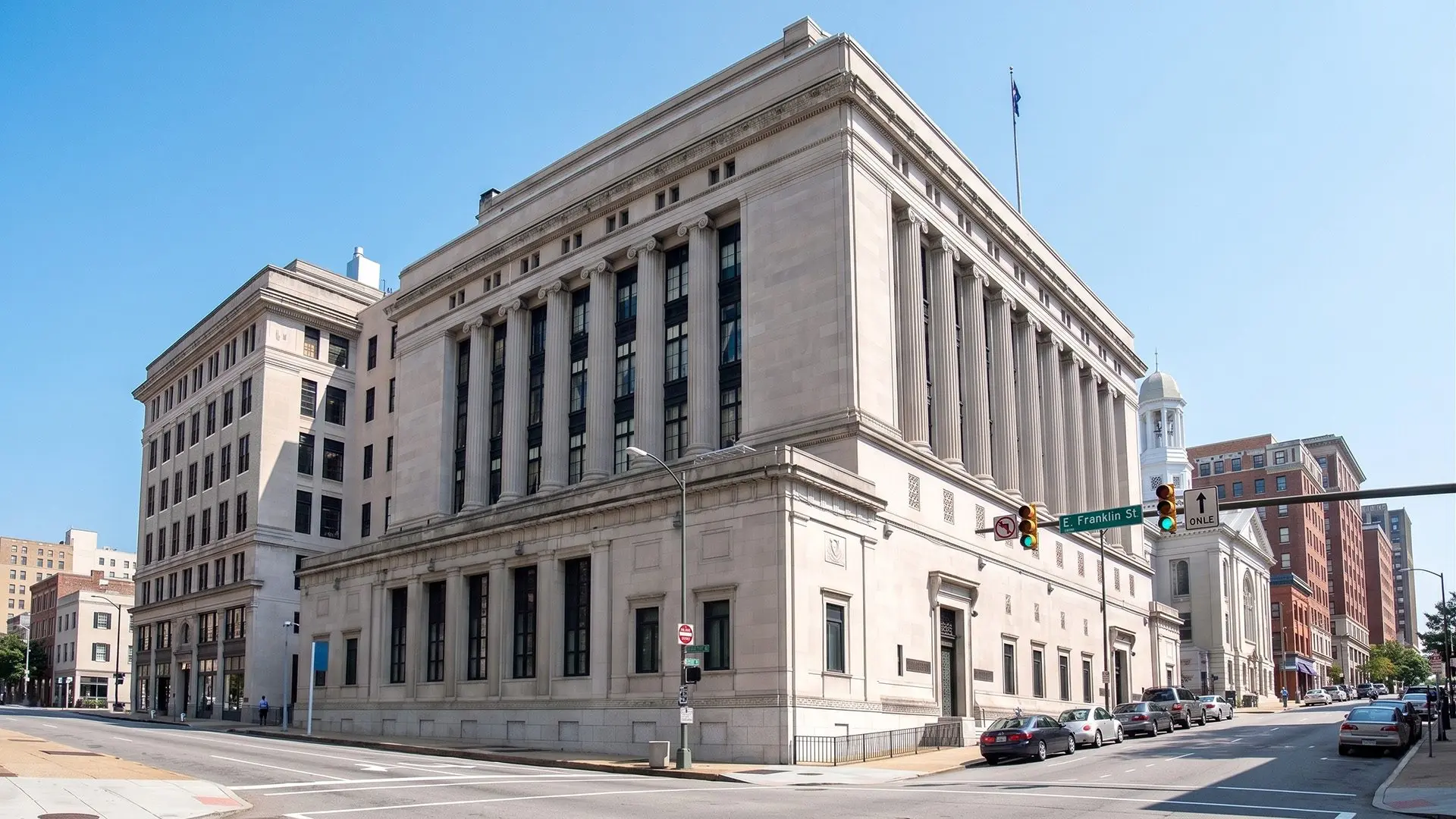
“SupremeCourtofVirginiaBuilding.JPG” by Morgan Riley is licensed under CC BY 3.0. Aspect ratio adjusted and frame extended.
THE SUPREME COURT OF VIRGINIA FULFILLS ITS ROLE TO SAY WHAT THE LAW IS—THE DEMOCRATS ARE SCRAMBLING TO SAVE THEIR UNLAWFUL MAP
INTRODUCTION
I write this as a lawyer who has practiced in courts all over the country for 44 years. I have appeared before the Virginia Supreme Court several times and have seen its Justices change with the political winds. My experience was always one of professionalism and deference to counsel’s arguments even when I knew my battle was uphill. I respected the Court and even had an opportunity to work with retired Justices, teaching at William and Mary Law School or working on a legal treatise. My first real case out of the Navy was against a young Arthur Kelsey, the author of this Opinion invalidating the redistricting push, when he was a rising star at the firm of Hunton and Williams. He is brilliant and will be removed during the next session because he dared to say what the law is as the author of this Opinion for the ages. His was an act of judicial courage that cannot be understated. Lawyers of integrity understand and accept the rulings of the Court and move on. Not this time. Numerous outlets have reported that on a conference call with House Minority Leader Hakeem Jeffries (no one in Virginia voted for him) and Virginia Democrats, everything from dropping the current mandatory retirement age of the Justices from 73 to 54 to remove the bench and replace it at the next session, to attempting to declare that the 2020 Constitutional Amendment creating the Bipartisan Redistricting Commission was invalid because it was not posted sufficiently 90 days before the vote, was floated. That’s rich. This would allow the General Assembly to redo its map. These are desperate measures capped by Attorney General Jay Jones asking the Court to stay its ruling so it can be appealed to the United States Supreme Court, where it will be swiftly and politely met with a “NO.” The United States Supreme Court is not going to substitute its judgment for Virginia’s highest court considering a matter of pure Virginia constitutional law. This is an embarrassing moment for an Attorney General who, in my opinion, is morally and professionally unfit for the position and who makes political and not legal arguments. The fact that the “people spoke” in the redistricting vote of March to April 2026 was by his own admission irrelevant to the real legal issue—what is an “election,” and what does that mean in the interpretation of the Virginia Constitution? Below I redact those critical portions of Justice Kelsey’s opinion for the 4-3 majority in which he was joined by Justices Russell, McCullough, and Chafin. The case was decided on the single issue of Article XII Section 1 of the Constitution of Virginia. The other issues of the legality of the Special Session and the 90-day notice issue were not ruled upon. This was wise and makes a successful appeal all but a nonstarter. The case is over, and the existing map directed by the Virginia Supreme Court and which still favors Democrats will be in effect in the midterms.
FACTUAL BACKGROUND
The majority looked at the statistics on the early vote up until the April 21st ending of the cycle, and the numbers of those who had cast early was staggering and they would be surprised to know they were not participating in the “election.” This helped drive the Court’s core reasoning on the “general election” issue.
Under the proposed new map, approximately 47% of Virginians that voted for representatives of one of the major political parties in the last congressional election would now be represented by 9% of Virginia’s delegation to the U.S. House of Representatives — while the approximately 51% of Virginians that voted for the other major political party would now be represented by 91% of Virginia’s congressional delegation. The General Assembly first submitted the proposed constitutional amendment to Virginia voters on March 6, 2026 — the first day of early voting. The submission was accompanied by a ballot asking voters to answer “yes” or “no” to the question whether they wanted to “restore fairness” in the upcoming congressional elections. Voting started on March 6 and ended on April 21. Of the total number of all votes, approximately 45% were cast during the early voting period and approximately 55% were cast on the final day of the election. The Virginia Department of Elections reported on April 30 that 1,604,276 Virginians had cast “yes” votes in response to the “restore fairness” ballot question and 1,499,393 Virginians had cast “no” votes. Approximately 3.38% of the total votes separated the number of “yes” votes and “no” votes, and thus, the majority will of the people was secured by “yes” voters representing 1.69% of the total votes cast.
This was, of course, the goal of Weezy Lucas and her minion Don Scott and one might wonder whether the “10 effing 1” T-shirts and her tawdry and condescending communications on the issue helped the Court over the finish line. Fairfax does not speak for most Virginians, and this small margin was doubtless from that lawless sanctuary county and other out-of-touch enclaves. This was not a mandate by any stretch. At the oral argument on April 27th the Commonwealth conceded that the voting result was not relevant to the core legal issues. In addition, the Commonwealth had urged the Court to withhold ruling until after the Referendum vote. Heeding longstanding precedent, the Court agreed but never lost sight of its vital role in any republic—to ultimately say what the law is.
THE CORE ANALYSIS
The majority started with the Virginia Constitution and the requirement of “strict compliance” with its provisions when it is to be amended.
Article XII, Section 1 of the Constitution of Virginia mandates a detailed process governing the lawful adoption of constitutional amendments. These procedural requirements may seem laborious to some, perhaps even painstakingly so. The ambition of a constitution, James Madison said, is to create “a Government for perpetuity” grounded by “permanent principles and not on those of a temporary nature. For this reason, amending the Constitution “necessitate[s] compliance with the requirements of a deliberately lengthy, precise, and balanced procedure.” Strict compliance with these mandatory provisions is required in order that all proposed constitutional amendments shall receive the deliberate consideration and careful scrutiny that they deserve.”
The opening sentence of Article XII, Section 1 states the first requirement for the nonconvention method of amending the Constitution of Virginia. In pertinent part, it provides: Any amendment or amendments to this Constitution may be proposed in the Senate or House of Delegates, and if the same shall be agreed to by a majority of the members elected to each of the two houses, such proposed amendment or amendments shall be . . . referred to the General Assembly at its first regular session held after the next general election of members of the House of Delegates. Under this provision, the General Assembly can propose amendments but cannot adopt them. The inverse is also true. Virginia voters can adopt or reject amendments but cannot propose them. This constitutional-amendment process of dividing power between the people and their politicians has withstood the test of time “for more than one hundred years.”
To guard against hasty changes to the Commonwealth’s organic law, Article XII, Section 1 also slow-walks the constitutional-amendment process. The General Assembly must twice vote in favor of a proposed amendment at two separate legislative sessions with an intervening election of the House of Delegates. This gives voters two opportunities — one indirect, the other direct — to voice their views on the proposed amendment. The first is during the intervening-election period between the two legislative sessions. Voters can support or defeat candidates for the House of Delegates who either endorse or oppose the proposed amendment. If the General Assembly votes against it at the next legislative session, the process ends there. If the General Assembly votes in favor of the proposal, voters get a second direct opportunity to vote the proposed amendment up or down at the ballot box. The efficacy of the second popular vote depends in part upon the reliability of the first.
THE COURT SAW THE FUNDAMENTAL FLAW IN THE DEMOCRATS’ PLAN, AND THERE IS NO DOUBT MANY IN THAT PARTY KNEW IT WAS AN UNLAWFUL POWER GRAB
The Court reasoned on:
In this case, voting in the general election for the House of Delegates began on September 19, 2025, and ended on Election Day, November 4, 2025. The General Assembly voted for the first time to propose the constitutional amendment to the electorate on October 31, 2025. By that date, over 1.3 million votes had been cast in the general election, which was approximately 40% of the total vote for that election cycle. The Commonwealth sees nothing wrong with this sequencing because, under its interpretation, the term “general election” in Article XII, Section 1 only means the last day of the election, November 4, otherwise known as “Election Day.” Because Election Day was four days after the October 31 vote to propose the constitutional amendment to Virginia voters, the Commonwealth concludes that there was an intervening election between the 2024 Special Session and the 2026 Regular Session.
… under the Commonwealth’s view, the four-day period (which included a weekend) was the “intervening” period during which Virginia voters could find out what the proposed amendment actually said, whether their preferred candidate supported or opposed it, and whether they wanted to use their vote to express a view on the subject. As for the 1.3 million or so Virginians in this case who had voted before October 31, the Commonwealth concedes that the “clear purpose” of the intervening-election requirement was to provide them with the constitutionally protected “opportunity to elect the House of Delegates that will participate in the second legislative vote on the proposed amendment. But early voters squandered that opportunity, the Commonwealth contends, by accepting the Commonwealth’s invitation to cast their votes during the 42 days of voting prior to the four-day period between October 31 (the day the legislature voted to amend the Constitution) and November 4 (the last day of voting in the election). Under this thesis, early Virginia voters unknowingly forfeited their constitutionally protected opportunity to vote for or against delegates who favor or disfavor amending the Constitution by not anticipating a legislative vote on a constitutional amendment four days before the last day of voting. To be sure, under the Commonwealth’s logic, the legislative vote could just as well have been one day before.
…imagine one of the over one million Virginians who had voted in person before Election Day in 2025 walking into a polling place. The voter says to the officer of election, “I am here to vote in the election.” The officer of election responds, “we are not conducting an election here.” “But that’s why I am here,” the voter replies. “Maybe so, but let me explain,” the officer of election insists, “you can vote in the election, but we are not conducting an election today. Elections are only conducted on Election Day.” Legal scholars and courts would have the same bewildered reaction as the hypothetical average citizen. The definition of “election” has always broadly denoted the “act of choosing.
THE HOLDING
For these reasons, we hold that the definition of “general election” in Article XII, Section 1 describes the combined actions of voters casting ballots and officers of election receiving those votes and closing the polls on the last day of the election. The plain and ordinary meaning of the expression matches the historical definition embraced by the courts and legal scholars. Article XII, Section 1 requires an intervening “general election” after the first legislative vote in favor of a proposed amendment and prior to the second legislative vote before the General Assembly has the constitutional authority to submit the proposal to the voters. In this case, the General Assembly passed the proposed constitutional amendment for the first time well after voters had begun casting ballots during the 2025 general election.
CONCLUSION
I have no doubt the Democrats will wreak havoc on the Court in the next session in biblical proportions that Samuel L Jackson would recite in Pulp Fiction tones. They are petty and vindictive, and one would hope that with Weezy’s legal issues and the embarrassing loss of face that even 60 million dollars couldn’t prevent, that Governor Spanberger vetoes any attempts to retire the Court and repack it. She needs to stop lying and misleading and attempt to seek the middle. Justice Arthur Kelsey knew he was done and authored this opinion which is flawless in its logic in the dismantling of a naked power grab. Virginia is different. We rebuked partisan gerrymandering. The Virginia Supreme Court appointed a commission that agreed on a map that was nationally praised. It will guide the next election regardless of the machinations that are being considered to ignore a ruling from the Commonweath’s highest Court. Don’t pile shame on shame Don and Weezy. It’s over.
Mike Imprevento
May 11th, 2026